

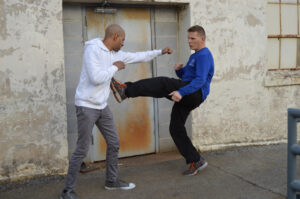
It’s a very easy mistake to make. I get it. People naturally, but illogically, think that a distance fighter isn’t as aggressive as one who fights on the inside. People think, “well, he’s staying at long range, so he’s scared to mix it up.” Or, “they’re using distance for their defense.”
In JKD, that’s all false. Terribly and dreadfully false. The fact is, we use distance in JKD as a sort of buy-one-get-one-free package deal. It’s about power. It’s about domination.
Before we cover all that let’s dismiss these false beliefs first, though.
On the first point, that is that inside fighters are more aggressive, this is simply an uneducated bias propagated by people who don’t mind watching other people lose brain cells so that they can be entertained. That says quite a lot about the type of person who views mindless aggression and mutual destruction as entertainment, doesn’t it? For example, the Gatti-Ward fights are famous for the almost complete abandonment of defense by both boxers. Sure, there was ample heart on display, but little else. On the other hand, most fans hated great boxers like Pernell Whitaker and Floyd Mayweather. Unless you’re a boxing purist you probably have never even heard of the Whitaker-McGirt match wherein the fighters were using high level feints and counters and angles. But the slugfest of Gatti-Ward is considered a classic.
As to infighters and aggression I give you early-Tyson. His mastermind trainer, the great Cus D’Amato, was so fixated on head movement and defense that he was derisively nicknamed “Cautious Cus” by the press at one point. The whole point of the Cus style, known popularly as the peekaboo, is that you should always attack off your defense and defend off your attack. Cus would tell young Mike that he had two rules: move your head before you punch and move your head after you punch. In other words, it wasn’t either-or, but both. Young Tyson even described himself as an “aggressive counterpuncher.” This is the great irony of Cus and Tyson: perhaps the greatest defensive style and fighter in boxing history is remembered solely for his destructive power, not his ability to avoid punishment. I wrote about this in “JKD Infighting” and how much overlap of theory there is in the Cus style with the idea of Lee’s Jeet Kune Do.
Oh, and what of Ali. He was, perhaps, one of the meanest men in boxing history! The jokes and all the “float like a butterfly…” poetry covered up the fact that, especially early in his career, that Ali was an assassin. Watch the Ali-Terrell fight to see for yourself. So much for the whole, “he’s using distance because he’s scared.”
Another great boxer that refutes the whole infighters are more aggressive nonsense is Tommy “the Hitman” Hearns. He was long, long, and deadly with his rapier jab and pulverizing right cross. You don’t get a nickname like “the Hitman” when you’re afraid to fight.
So, this is what we’re talking about in JKD. Like Hearns and Ali, we use distance for offense, not merely defense. Sifu Jonathan Parsons said, “We use the distance to create power! Power comes from torque and leverage. That’s what we want. We use that space to scientifically use momentum from the rear heel, the waist and shoulders in every hit we can. Without adequate power the guy can trade with you.
“Now, don’t get me wrong, the extra distance is great. It does give you the defensive advantage but you have to have the footwork and the power or else it’s useless and the guy will just close the gap anyway.”
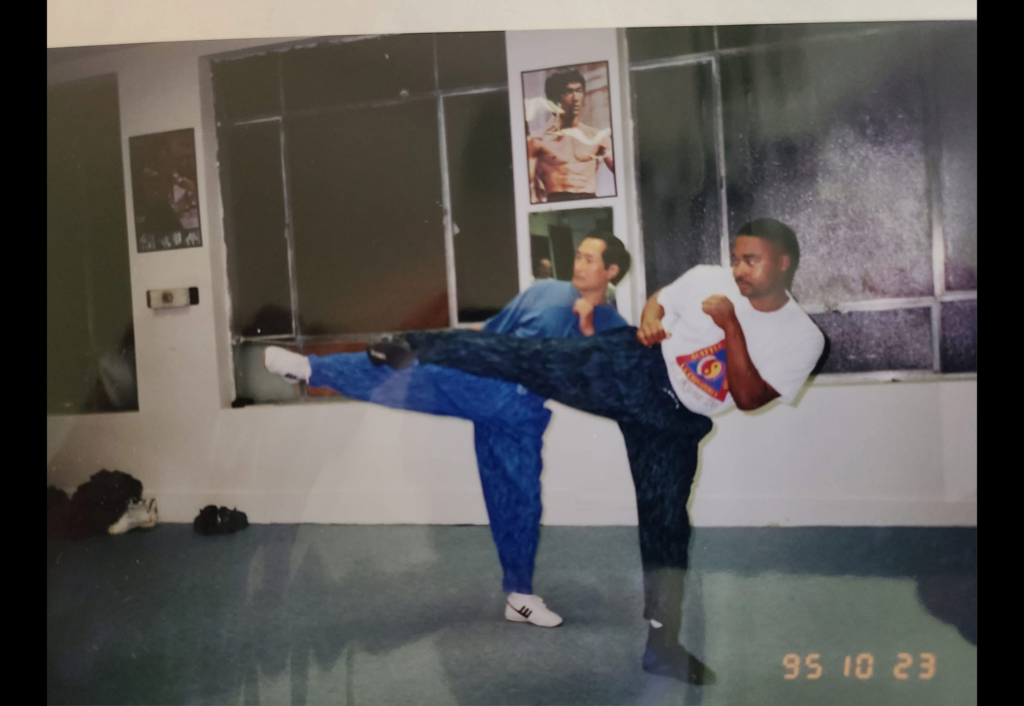
The distance is weaponized via footwork, feints, and timing. Since those qualities are in such short supply by the enemy because they require careful thinking and hard work, which rules out ruffians and tough guys, the JKD fighter seeks to force feed him a steady diet of crippling blows on the move. Like with Tyson, the point isn’t to simply hit him as hard as possible. No. That’s oversimplification and it leads to brawling. The goal is, as we said, a “package deal” of offensive-defense.”
This takes time to develop, of course. We’re all natural brawlers, not scientific fighters. In JKD we train to integrate all elements of structural mechanics and tactics toward the goal of taking out the threat as efficiently as possible. Such is the great paradox of fistic science: the best defense is a good attack. The systematic of Jeet Kune Do is that of the ready-position that’s ready to fire non-telegraphic bombs at the nearest, most vulnerable target with the longest tool, and the footwork that moves that ready-position. Everything else proceeds and flows from this platform.