

No man can do the impossible: he can’t hit what he can’t reach. Learn to master the distance with JKD’s fighting measure.
Jeet Kune Do’s unique use of the fighting measure and footwork will turn a fight into a violent game of tag. And the enemy is always ‘it.’
For these reasons, without mastery of the fighting measure, there’s no JKD.
The fighting measure is the no tailgating rule of fighting. Police call it the reaction gap. It’s a critical fistic truth hiding in plain sight (reaction time) and yet so many of us ignore its absolutely critical role in all-out combat. The idea is to force the enemy to move to us in order to land a blow. To violate this essential rule leaves the defender (that’s us…we didn’t start the fight) in jeopardy. Why? Again, it’s simple:
Reaction time.
The fighting measure is the recognition of the reflex lag. A police officer once told me that the majority of traffic accidents could be avoided with one more second of reaction time. In other words, people are “guilty” of following too closely. Naturally, the faster one is driving, the more space they need to react. It’s the same thing with self-defense. Once understood and mastered, distance is your friend. And, indeed, a weapon. It turns a fight into a violent game of tag…and the enemy is always it.
One could say that Jeet Kune Do is a fighting measure art. Think of it this way: JKD is like Chi-sao without the touch. Imagine doing sticky hands with a partner but your form is bad. Your middle is wide open. What’s going to happen? You don’t need to be Nostradamus to figure that out and it’s precisely why Wing Chun trains assiduously to control the center.
But, absent touch – that is, contact control – distance is your friend and your enemy’s enemy. Thus, JKD is a science of distance control and the integration of the fighting measure, ready-position, footwork and the leading hand/foot are key.
Obviously, you can’t just stand there. The fighting measure doesn’t help unless you know how to integrate it. And this brings us to the subject of footwork.
Many instructors treat footwork and distance control as though they’re college professors forced to teach grade-school stuff. This exposes their lack of understanding. If we use the measure to shut down the enemy’s offense and force him to attack in ways we can stop-hit and counter, we must have footwork that allows us to make split-second adjustments. This requires a coordinated package-deal of the JKD ready-position (bi-jong) and footwork.
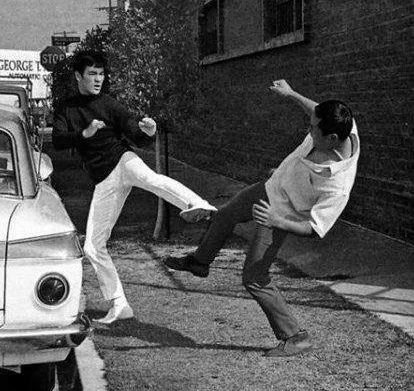
The “ready” position is ready to fire non-telegraphic straight bombs at the nearest, most vulnerable target. The footwork moves the ready-position. The fighting measure is the gauge used, the ruler, that guides and informs the footwork and striking. In Bruce Lee’s copy of Crosnier’s Fencing With the Foil we read:
“The fencer practicing his footwork will find that his mobility will be greatly handicapped if his on-guard is not perfect…he will readily appreciate, then, the necessity of paying attention to his basic stance and position on guard.”
As with the fencer, so with the Jeet Kune Do fighter. In order to properly apply the straight lead punch, the eye jab, the groin or knee kick – those lightning fast and devastating tools of defense – we must master the fighting measure. In all: to do JKD requires mastery of the fighting measure. This is to say that we must become masters of distance control! And this means footwork, footwork, and more footwork.
But not the sort of footwork that bounces around for no particular reason. We’re talking about the stalking, hunting style movement that seeks to use the fighting measure to both shut down the enemy and force him into mistakes. That mistake might be nearly instant. It might take some time. When isn’t the point. The point is that wandering the battle field without reference to the fighting measure is playing with fire. It’s like going to my mother-in-law’s…something bad is bound to happen. (Just a joke…she’s a sweetie).
To this end, the rear heel in JKD is always raised. It’s the piston of the whole fighting machine and the distance regulator. It’s poised at all times to push you forward to deliver a blow or move you safely out of reach. It’s always ready to keep you where you’re safe and the enemy is not. It’s for this reason that JKD footwork is much more fencing style than anything else. Ted Wong once said: “In boxing, if I hit you and you hit me we’re having an exciting fight. In fencing, if I hit you and you hit me, we’re both dead.”

To that end, we hit with power while moving like a fencer. The fighting measure can’t be weaponized without the careful practice of JKD’s “push-shuffle” attack. To seize the moment when the enemy is offset, launch a straight punch at the same moment your rear foot pushes you forward. The leading foot, therefore, moves slightly after the punch starts. This push from the rear foot shoots you into the zone and hammers the blow home. The front foot lands a split second after the punch, then the rear foot shuffles forward and you’re back in your perfectly balanced on-guard position, ready to follow up or, you guessed it, reestablish the fighting measure.
The thing is, again, without mastery of the measure, there’s no JKD! Every technique and tactic within the system uses and presumes it.